I was set to hate it. I felt I had to. It was made in China, and while I think CFMoto, on general principles, makes pretty good bikes, what business does it have attempting an in-line four? That engine configuration is the stuff of legend. The Chinese want to splash in that pond, they wanna bring their A-game.
 How is that not cool?
The SR-S was indeed an in-line four, and I’d sharpened my fangs on in-line fours back when they breathed fire, hailed Satan, and tank-slapped their way to red-line.
I kept riding in-line fours after the Japanese engineered the tank-slapping out of them, and their unique shriek will always be one of the great songs of my people. Nothing assaults your ears and screams “Fast” like an in-line four being hammered through the gears.
It all began in 1969 with the Honda CB750-Four, the bike that started the so-called superbike era. The prototype was unveiled in 1968 at the Tokyo Motor Show, and the first production bikes arrived in the USA the following year. Kawasaki upped the ante when it unveiled its 900cc Z1 in 1972…and away we all went.
 It also comes in white. But there’s no need for that.
In-line fours got bigger, went a hell of a lot faster, and schooled several generations of riders in sheer terror, while simultaneously addicting them to industrial doses of adrenaline and jail.
Around the turn of the century, it was decided that 1000cc was kinda the right capacity for an in-line four superbike, and while Suzuki flirted with a 1400cc in-line four from 2011 to 2008, that fat bastard was never a contender for the superbike crown. Suzuki was alright about that. It also produced what many still believe to be the finest in-line four ever made – the K5-engined GSX-R1000 – which was itself the obvious performance progression of the just-as-legendary GSX-R750, the bike that defined “handling” 25 years ago. Suzuki figured it would just jam its 1000cc monster engine into that wickedly agile 750cc bastard to see if it danced.
 Yeah, look…those inserts do come off with a set of Allen keys. Pipes are nice.
It did. But to many people, the GSX-R750 still danced just that little bit better. The 1000 went harder, but the 750 handled sharper. That was the argument. And the argument was ultimately settled by the market. Suzuki stopped making the GSX-R750 in 2016, but it was essentially the same bike it had made in 2011. The GSX-R750 was still being sold in the USA up until 2019, but that was just unsold 2016 stock.
The in-line 1000 had won out. Size mattered, it seemed.
But ask anyone who has ever ridden the GSX-R750 and the GSX-R1000 which one handled better, and they will tell you it was the 750. It was always the 750.
 The front LED lights are glorious. The aero is decorative.
We now live in a world where in-line fours are all 1000cc track monsters, and the market all seems to be about parallel twins – the sensible cardigan of the motorcycle world.
Older riders, who once sold important organs to buy in-line fours, are now too old and too scared to even care what 14,000rpm in top means on an in-line four. Younger riders are far too risk-averse and have been bludgeoned by legislation and the policing that goes with it to even think about red-lining an in-line four in all six gears.
 Some quality right there.
So why the Hell would CFMoto produce an all-new four-cylinder in-line 750? It was going great guns with its parallel twin offerings. They were incredible bang-for-your buck, improving with each model run, and absolutely making the big Japanese Four sit up and pay attention.
Why this four-cylinder winged thing, with its strange rear wheel, and cutting-edge suite of electronic whizz-bangery?
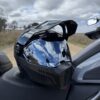
 Looks trick from the rider’s POV.
No idea, and I could care less. Maybe the Chinese are just throwing this 750 SR-S out there to see what would happen. Maybe they wanted to make the Japanese crazy. Maybe it was a little of both.
And I was determined to hate it. And then I saw it in the flesh and thought: That’s not too bad, actually. Sure, the rear wheel looks like it’s meant to slice giant potatoes, but close inspection revealed those munted inserts could be removed with an Allen key and thrown into the sea.
The rest of it looked cool. Very cool. But I was certain it was not going to be a GSX-R750 when I rode it. And I was right. It was not. It was a very long way away from Suzuki’s epic sportsbike statement.
 It’s slim, which is not what I am.
CFMoto’s SR-S is a very different statement. Sure, you hit the starter button and it instantly fires into that intoxicating angry beehive hum only an in-line four can make. I remember looking at it after I started it up and muttering: “Well, you certainly sound like you mean business…”
And it did, but it was a different kind of business. It was a business for our time. A gentler, friendlier, easier-to-ride kinda business, because we live in just such a world – or we’d like to. Or the government would like us to. So the SR-S is not the GSX-R.
For starters, there is no racer’s crouch happening here. You sit canted forward, but not in a way that puts all your weight on your arms and forces your neck back. Think sports-tourer rather than sportsbike.
 This wins as the most modern rear-blinker array so far.
It seemed to handle well, but it was shod with Maxxis SP tyres, and I could not bring myself to see how they dealt with me at Max Stupid. I’m funny about tyres. Most people are. There are brands you like and trust and there are brands you don’t. I have had nothing to do with Maxxis. I read good things about them, but the Internet is full of lies.
Ridden at a few degrees less than Max Stupid, they seemed fine. I left it at that. The SR-S tipped in sweetly and held its line – and crucially, it did not lash out viciously when you gassed it on hard. Yes, this was certainly no GSX-R750. It didn’t seem to be strangled performance-wise. It just wasn’t angry.
Looking at the numbers, it made sense. The CF‑Moto SR‑S750 makes 110 hp with 80 Nm of torque and weighs 213 kg, while the Suzuki GSX‑R750 makes 148 hp, has 86.3 Nm and weighs 190 kg. The wheelbase and rake comparisons are also revealing. The SR-S is 1419mm long and the GSX-R is 1390mm long. Their respective rakes are 24.5 degrees and 24.6 degrees.
That there should tell you everything you need to know about why it’s not a GSX-R750. The SR-S is a slower-steering, slightly pudgier, and markedly less powerful bike than the legendary GSX-R750.
 The Chinese are no longer “coming”. They are here.
But then it’s not trying to be one of those. Those days are gone. The people who wanted those numbers, or told themselves they did, are no more. The SRE-S is very much an in-line four 750 for our time.
It is as modern as drone warfare. There is no key. There is no fob. There is a small black plastic thing a third the size of a credit card with which you touch a place on the inside left of the fairing. Then all its lights come on in a celebration of electric modernity. I hated that wee plastic thingy. I am guaranteed to lose such a starting gimmick.

I hate fobs too. They solved a problem no-one was having. I can spend three days riding through rivers, jumping into oceans, and being rained on, and my bike key will still start my bike. My fob won’t. My key does not require batteries. My fob does.
 The rider’s seat gave me nothing to moan about. But I’m thinking the pillion would complain. And she’d block the air flow through the tail-piece. I’d leave her at home.
The SR-S750s starting “card” has no battery, and it may well work if I leave it in the sink overnight, so it may be an improvement on the fob. But I am primitively confident that whatever sorcery makes it speak to the fairing will, at the worst possible time, cease to speak to the fairing.
But young people will love it. Technology does not mortify them like it does me. And they will be pleased you can also lock and unlock the thing with a password, Bluetooth, or via the CFMOTO RIDE app. There is also a three-way electric lock that does your steering, seat, and petrol cap.
 Brakes like it when you blow on them.
Once all the lights come on and you start it and are greeted with that lovely deep engine hum, riding it is a doddle. And it’s so smooth, like Chinese silk. This is no small thing. In-line fours all had a certain amount of handlebar “buzz” in them. It used to be hand and mind-numbing, but it got better as time went by, and then only really bothered people up near red-line. The SR-S750 was amazingly almost vibe-free.
 It’s just a normal rear wheel from the left-hand side.
Like I said, the ergos are not sportbike ergos, and it is fuelled beautifully by Bosch. It’s just not going to shoot you at the horizon like you might think it will, given its looks and aero bits.
Displayed on social media, the SR-S copped some flak for its fairing-mounted wings. From old people, mainly. The same old people who criticise the aero on BMW’s S1000RR and Ducati’s Panigale and view it as pointless. Thing is, the aero on those bikes does work. But you really have to be going seriously fast for it to do so. The SR-S750 does not go that fast. Most riders don’t go that fast either. So, its aero is a styling thing.
Happily, there is an enormous amount of suspension and braking integrity to the bike, and its suite of electronics is top-notch – cornering ABS, Traction Control, and a Tyre Pressure Monitoring system are standard.
 It offered the odd Gremlin.
The suspension up the front is a set of fully adjustable KYB 43mm USD forks, and there’s a fully adjustable KYB monoshock on the rear bolted to a single-sided swingarm. The brakes are four-piston 320mm Brembos up front, and a 240mm twin-piston unit on the back.
There is a 6.2-inch TFT dashboard, and you can spend quality screen-time wandering through its permutations and info displays. It has a slipper clutch, and a quickshifter, which only works on the upshift, and it seemed a bit glitchy now and again. Sometimes it worked fine. Sometimes not at all. I’m certain this was an anomaly and not anything your dealer couldn’t immediately sort should you get this issue. No-one I spoke to who had ridden an SR-S had this problem.
 After a few weeks with it, I started not to mind the rear wheel thingies.
Crucially, it didn’t feel or look cheaply made, and it was great to ride. It felt sorted and stable. There was no twitchiness on fast direction changes, and the engine made exactly the right in-line four noises when I got enthusiastic. And it didn’t make me feel fat, crippled, and slow, like a GSX-R750 always did. It’s way too friendly for that.
Personally, I’m strangely pleased someone re-invented the in-line four 750. It was always, and still is, a very cool engine configuration. That it is wedged into a modern, and very sassy-looking bike with great brakes and suspension should be celebrated.
And here’s the best bit. That this package costs a ridiculous $AU12,990 ride-away simply beggars belief. I’m going to give CFMoto a round of applause.